
Strong cash flow management helps real estate companies maintain liquidity, meet financial obligations, and plan for future investments. Regular forecasting, adequate reserves, and proactive monitoring can prevent many common cash flow challenges. A disciplined approach to cash flow strengthens both day-to-day operations and long-term financial stability.
Real estate looks profitable on paper right up until it isn’t. A residential landlord with twelve units and solid occupancy can still end up short in October when three HVAC systems fail the same week the property tax installment is due. A commercial developer carrying a strong portfolio can run out of operating cash mid-project because draw requests got delayed, and a key tenant pushed back their move-in date by sixty days. A property management company with billing fees on $40 million of assets under management can still miss payroll if the float between client trust accounts and operating funds isn’t managed carefully.
That’s the particular challenge of real estate cash flow management. The assets are large, the income is often predictable in theory, and the timing gaps are significant. Revenue arrives in lumps. Expenses don’t wait. And the line between ‘this business is doing well’ and ‘this business has a cash problem’ can be a lot thinner than the balance sheet suggests.
This blog covers the core principles of real estate cash flow management for North American real estate companies It discusses what causes cash flow problems in this sector specifically, and what the companies that manage it well actually do differently.
Why Real Estate Cash Flow Management Is Different from Most Businesses
What makes real estate cash flow different from other business’s is that : the assets are huge, and the cash can still run out. Not because the portfolio is performing badly, but because money comes in on one schedule and goes out on a completely different one. the gap between the two doesn’t care how much your properties are worth on paper.
Take residential rent. It is intended to be reliable. And it is, mostly, until a tenant stops paying, and the eviction process runs five months, or three units turn over in the same quarter, and the leasing and make-ready costs hit before the new rents start. Or just a slow August where half your tenants are late and your property tax installment landed on the 1st. None of those things are disasters. They’re just the normal texture of owning residential real estate, and they all squeeze cash at the same time.
Commercials are worse in some ways. The rents are larger and more reliable, right up until an anchor tenant in your strip center doesn’t renew, and suddenly 35% of your monthly collections evaporate. Commercial vacancy doesn’t fill in a few weeks. Depending on the market and property type, you might be carrying that hole for six to eighteen months while paying for the full mortgage the whole time.
Then there’s the expense side, which doesn’t flow smoothly either. Property taxes across most US states land in two or four large installments a year. Insurance renews in a lump. The HVAC that’s been running over a decade doesn’t send a warning; it just fails in July, when the building is full, and the tenants are unhappy. Elevator overhauls, parking lot resurfacing, roof replacements: all of these hit large one-time outflows in years when the operating budget had no line for them because nobody scheduled a reserve contribution when they should have.
And underneath all of it: debt. Most real estate portfolios are heavily leveraged, which means mortgage payments go out every month regardless of what came in.
On commercial loans, lenders typically require a debt service coverage ratio of at least 1.20x to 1.25x, NOI has to exceed debt service by that margin or you’re in covenant territory. A bad quarter doesn’t just hurt your returns. It can put you in a conversation with your lender you didn’t plan to have. That’s the specific pressure that makes real estate cash flow management different from running almost any other kind of business.
How to Manage Cash Flow for Real Estate Companies?
Managing cash flow for real estate companies requires having a baseline cash reserve of about three to six months of operating expenses before anything else. This reserve provides the business with a cushion to fall back on during periods of potentially low cash inflow. In a similar vein, the following section provides many cash flow management tips:
Tip 1: Build a Real Cash Flow Forecast, Not Just a Budget
A budget tells you what you plan to spend and earn. A cash flow forecast provides information on expected cash inflows and outflows over a specific period. In real estate, the difference between those two things is where most cash crunches actually live.
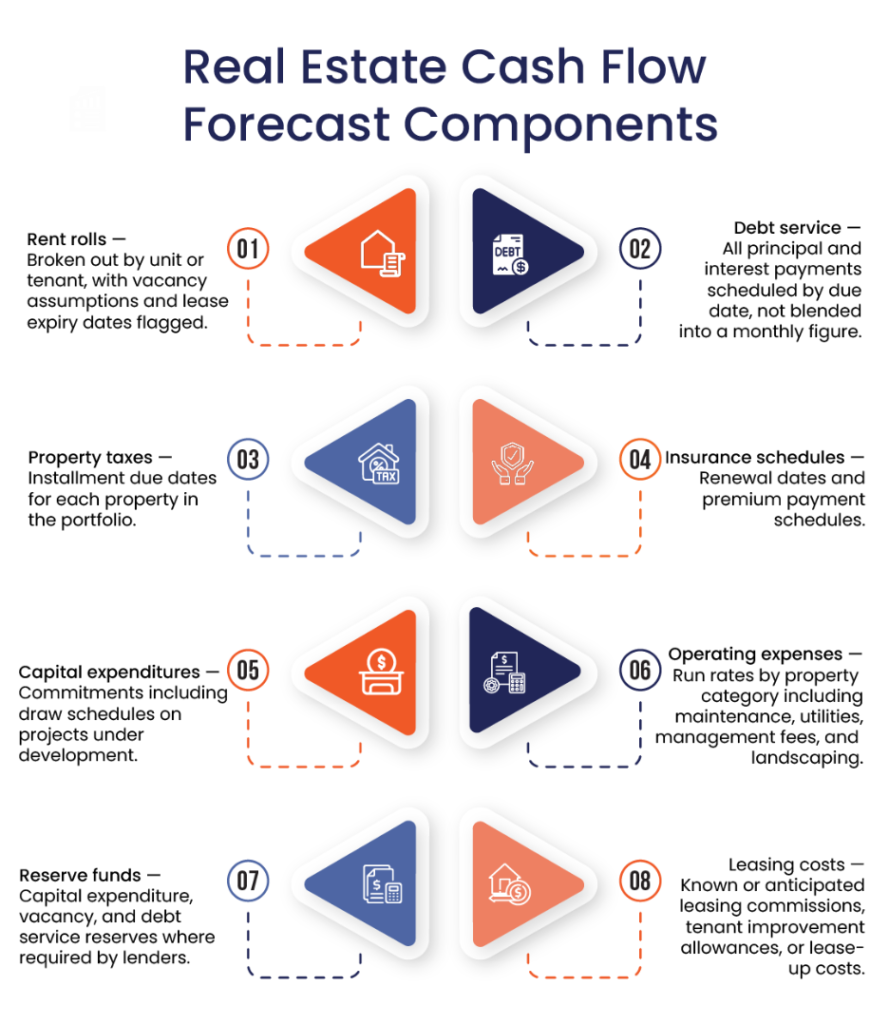
The companies that manage real estate cash flow well, maintain a rolling 13-week cash flow forecast at the operating level, a week-by-week projection of every inflow and outflow expected over the next quarter. Not a high-level summary. A granular schedule: rent collections by property, scheduled mortgage payments, property tax due dates, insurance renewals, vendor invoices coming due, payroll runs, and any capital expenditure commitments.
Thirteen weeks sounds like a lot of work. In practice, once the template exists and the recurring items are populated, it takes maybe two hours a week to update. What it gives you in return is advance visibility into cash gaps. The future weeks when you will spend more than you make, with enough time to fix it. Draw on a line of credit before the gap arrives rather than after. Accelerate rent collection. Defer to a discretionary capital project.
At the portfolio level, a 12-month cash flow projection, updated monthly, serves a different purpose: it’s the tool that lets you plan capital expenditure cycles, time refinancing, and assess whether the portfolio can support a new acquisition without straining operating liquidity.
Tip 2: Tighten Rent Collection Processes
Rent is the foundation of real estate cash flow. It sounds obvious. And yet a surprising number of real estate companies, including ones managing tens of millions of dollars in assets, treat rent collection as an administrative function rather than a financial one.
The gap between rent due and rent received matters. A $3,500 monthly residential tenant who consistently pays on the 8th instead of the 1st costs the portfolio a week of float on every payment. At scale, that adds up. In a commercial portfolio, a tenant who routinely pays 30 days late on a $25,000 monthly lease is effectively providing themselves with a $25,000 interest-free working capital facility at your expense.
What tighter collection looks like in practice
- ACH or direct debit enrollment for all residential tenants where state law permits , collected on the due date, not at tenant convenience
- Online payment portals (AppFolio, Buildium, Yardi) that make it as easy as possible to pay on time and create a clear paper trail for every transaction
- Late fee enforcement from day one, applied consistently and automatically, not selectively based on who calls to complain
- A collections escalation protocol with defined timelines: reminder on day 3, formal notice on day 5, attorney engagement at 30 days for commercial, earlier for residential where eviction timelines are shorter
- Monthly AR aging reviewed by ownership or management, not just the property manager, so patterns of slow payment are visible at the portfolio level, not buried in individual property reports
Tip 3: Fund Reserves Properly, Before You Need Them
The most common source of cash flow emergencies in real estate is not bad luck. It’s underfunded reserves meeting a predictable expense. HVAC systems have known useful lives. Roofs have known useful lives. Parking lots need resurfacing on a schedule that anyone who has owned commercial real estate for more than five years can estimate. The money for these expenses should be accumulated monthly, not scrambled for when the work order arrives.
Capital expenditure reserves
Industry practice for residential portfolios is to reserve $100–$200 per unit per month for capital expenditure, depending on the age and condition of the properties. For commercial real estate, the reserve calculation is typically based on a percentage of replacement cost or a per-square-foot reserve, commonly $0.10 to $0.25 per square foot annually for well-maintained Class B and C properties, higher for older assets.
These aren’t suggestions. They’re the buffer between a roof replacement being a planned capital project and a cash flow crisis. Lenders on commercial properties increasingly require funded reserves held in escrow as a condition of financing, which is the market’s way of acknowledging that underfunded reserves are a credit risk, not just an accounting preference.
Vacancy reserves
Vacancy is a cost, not just the absence of income. A vacant unit still incurs carrying costs: mortgage, taxes, insurance, utilities, and the leasing commission and tenant improvement allowance that will be required to re-lease it. Companies that plan their real estate cash flow management well reserve for expected vacancy based on their historical average, not on the optimistic assumption that every unit will be occupied every month.
Tax and insurance reserves
Property taxes and insurance premiums are large, predictable, and periodic. The correct approach is to divide the annual liability by 12 and set aside that monthly amount into a dedicated reserve account, so when the installment is due, the cash is there. Many commercial lenders require this through impound or escrow accounts as a loan condition. For portfolios without lender-required escrows, self-managing this reserve is basic cash flow discipline.
Tip 4: Separate Operating Cash from Capital Cash
One of the most reliable ways to create a cash flow problem in real estate is to run everything through a single operating account. Operating revenue, capital expenditure funds, security deposits, reserve contributions, and debt service payments all flowing through the same account makes it nearly impossible to know at any given moment how much of the balance is actually available for operations.
The discipline of separate accounts isn’t just organizational. It’s a real estate cash flow management tool. When capital reserve funds are held in a dedicated account, they’re not accidentally available to cover a temporary operating shortfall. When security deposits are held in a separate trust account, as required by law in most US states and Canadian provinces, they’re not at risk of being swept into operating expenses during a tight month.
| Account Type | Purpose | Key Considerations |
|---|---|---|
| Operating Account | Used for day-to-day financial activities, including rent collections, vendor payments, payroll, and routine operating expenses. | Serves as the primary account for managing regular cash inflows and outflows. |
| Capital Reserve Account | Holds monthly reserve contributions for capital expenditures (CapEx). | Funded separately from operating cash and used only for approved capital improvement projects. |
| Security Deposit Trust Account | Stores tenant security deposits in accordance with applicable state or provincial regulations. | Must never be commingled with operating funds to maintain legal compliance. |
| Debt Service Reserve Account (DSRA) | Maintains funds for future debt service obligations on commercial properties. | Typically required by lenders and often controlled by the lender or a third-party custodian. |
| Development or Project Account | Dedicated account for each active real estate development project. | Funded through equity contributions and construction loan draws, and kept completely separate from portfolio operating cash. |
Tip 5: Manage Debt Maturity and Refinancing Timing Actively
Debt is the largest single fixed cost in most real estate portfolios. Managing it well isn’t just about getting the lowest rate; it’s about managing maturity profiles, so you’re not facing multiple refinancing events simultaneously during a period of rising rates or tightening credit conditions.
Commercial real estate loans in North America typically have terms of 5, 7, or 10 years with 25, or 30-year amortization schedules. That means balloon payments arrive regularly, and when they arrive at the same time across multiple properties in a portfolio, the refinancing pressure can be significant. Staggering maturities deliberately, even at a slightly higher interest rate in some cases, reduces the concentration of refinancing risk in any single year.
Interest rate risk is also a real cash flow variable. A portfolio carrying $10 million in floating-rate debt at prime plus 1.5% will see its annual debt service increase by $100,000 for every 100 basis points the benchmark rate moves. For portfolios that haven’t stress-tested their cash flow against rate scenarios, that’s the kind of number that turns a comfortable DSCR into a covenant concern.
Best Practices for Debt management that protect cash flow
- Track all loan maturity dates in a central schedule, reviewed quarterly, no balloon payment should arrive as a surprise
- Begin refinancing conversations with lenders 12 to 18 months before maturity, not 60 days before
- Stress-test NOI and debt service coverage at rates 150–200 basis points above current levels for any floating-rate exposure
- For portfolios with significant near-term maturities, model the cash flow impact of refinancing at current market rates, particularly relevant when rates have moved materially since the original loan was placed
- Consider interest rate caps on floating-rate construction or bridge loans, the premium is a known, budgetable cost; the alternative is an unbudgeted exposure
None of this requires a treasury department. It requires someone to keep a spreadsheet current and review it with ownership on a quarterly basis.
Tip 6: Get the Reporting Right
You can’t manage what you can’t see. That’s true in any business, but it’s particularly true in real estate, where the relationship between what’s on the income statement and what’s actually in the bank is complicated by timing, accruals, and the way depreciation and amortization affect reported income without affecting cash.
A lot of real estate companies look at their P&L and think they understand their financial position. The P&L doesn’t show you when the property tax installment is due. It doesn’t show you that three leases are expiring in Q2 and the lease-up cost to re-tenant them is going to hit operating cash in Q1. It doesn’t tell you whether the reserves are funded at a level that can absorb the roof replacement that’s been on the deferred maintenance list for two years.
What to Avoid During Cash Flow Management for Real Estate
Most cash flow problems in real estate companies are predictable in hindsight. Certain patterns consistently emerge across real estate portfolios, regardless of their size or asset type. Identifying these common pitfalls early allows property owners, asset managers, and finance teams to strengthen liquidity, improve financial planning, and reduce the risk of unexpected cash shortages. The following are some of the most common cash flow management mistakes and why they can have a significant impact on a real estate business:
| Cash Flow Mistake | What Happens | Potential Impact |
|---|---|---|
| Treating Paper Profit as Cash | Distributions are based on accounting profit instead of actual cash available. | Cash shortages and overdrawn operating accounts. |
| Underfunding Capital Reserves | Reserve contributions are deferred until major repairs become unavoidable. | Unexpected CapEx costs strain operating cash flow. |
| Concentrating Lease Expirations | Too many leases expire within the same period. | Simultaneous vacancies, leasing costs, and reduced rental income. |
| Ignoring CAM Reconciliation Timing | Annual CAM settlements are not included in cash flow forecasts. | Unexpected tenant refunds or reimbursement timing issues. |
| Mixing Restricted and Operating Funds | Security deposits, reserves, and operating cash are kept in one account. | Poor cash visibility and accidental use of restricted funds. |
| Waiting to Arrange a Line of Credit | Financing is sought only after cash flow problems arise. | Slower approvals, higher borrowing costs, and limited liquidity. |
Final Thoughts
Real estate cash flow management isn’t complicated in theory. Income in, expenses out, plan for the gaps, fund the reserves, watch the debt. The challenge is execution, maintaining discipline when times are good, so the discipline is already in place when times are not.
The companies that navigate cash flow well in real estate share a few common traits. They know their numbers at a level of detail that goes beyond the annual accounts. They look forward, not just backward. They’ve separated the different types of cash in their business, so they always know what’s actually available. And they’ve built the reserves before they needed them rather than after.
If your real estate portfolio is growing and the financial reporting hasn’t kept pace with the complexity, or if cash flow feels more reactive than planned, that’s a practical problem with a practical solution. AcoBloom works with real estate companies across North America on exactly this kind of work.
Frequently Asked Questions
The basic formula for real estate cash flow is:
Cash Flow = Total Cash Inflows − Total Cash Outflows
Cash inflows typically include rental income, parking fees, late fees, and other property-related revenue. Cash outflows include operating expenses, property taxes, insurance, maintenance, utilities, management fees, loan payments, and capital expenditures. A positive cash flow means the property generates more cash than it spends, while a negative cash flow indicates that expenses exceed available cash. Property owners often monitor this metric monthly to evaluate liquidity, meet financial obligations, and make informed investment decisions.
Consider a multifamily property that generates $50,000 in monthly rental and ancillary income. During the same month, the property incurs $18,000 in operating expenses, $12,000 in mortgage payments, and $5,000 in planned capital improvements. The property’s monthly cash flow would be:
$50,000 − ($18,000 + $12,000 + $5,000) = $15,000
In this example, the property produces a positive monthly cash flow of $15,000. If unexpected expenses arise or occupancy declines, that cash flow may decrease, highlighting the importance of maintaining reserve funds and regularly updating cash flow forecasts.
There is no universal benchmark for a “good” Net Operating Income (NOI), as it depends on the property’s size, location, asset class, and investment strategy. In general, a higher and consistently growing NOI indicates that a property is generating strong operating performance before financing costs and taxes. Investors typically evaluate NOI alongside capitalization rate (cap rate), occupancy levels, operating expense ratios, and local market conditions rather than relying on NOI alone.
Rather than comparing NOI across different properties, it is often more meaningful to assess whether a property’s NOI is increasing over time, keeping pace with market conditions, and supporting debt service, capital improvements, and investor return objectives. Stable or improving NOI is generally viewed as a positive indicator of a property’s financial health and long-term value.
Real estate companies should update their cash flow forecasts at least monthly, although organizations with large portfolios, active developments, or seasonal income fluctuations often benefit from weekly forecasting. Regular updates allow finance teams to account for rent collections, operating expenses, debt payments, capital projects, and upcoming lease events before they affect liquidity. Forecasts should also be revised whenever there are significant changes, such as major tenant move-outs, refinancing, acquisitions, or unexpected maintenance expenses. Frequent forecasting helps management identify potential cash shortfalls early and make proactive financial decisions.
While profitability measures whether a property or portfolio earns an accounting profit, cash flow determines whether the business has enough liquidity to meet its day-to-day financial obligations. A real estate company can report strong profits but still face cash shortages due to loan repayments, capital expenditures, tenant payment delays, or non-cash accounting items such as depreciation. Effective cash flow management ensures there is sufficient cash to pay vendors, maintain properties, service debt, and fund future investments. For this reason, lenders, investors, and property owners often place as much emphasis on cash flow as they do on reported profits when evaluating a real estate business.